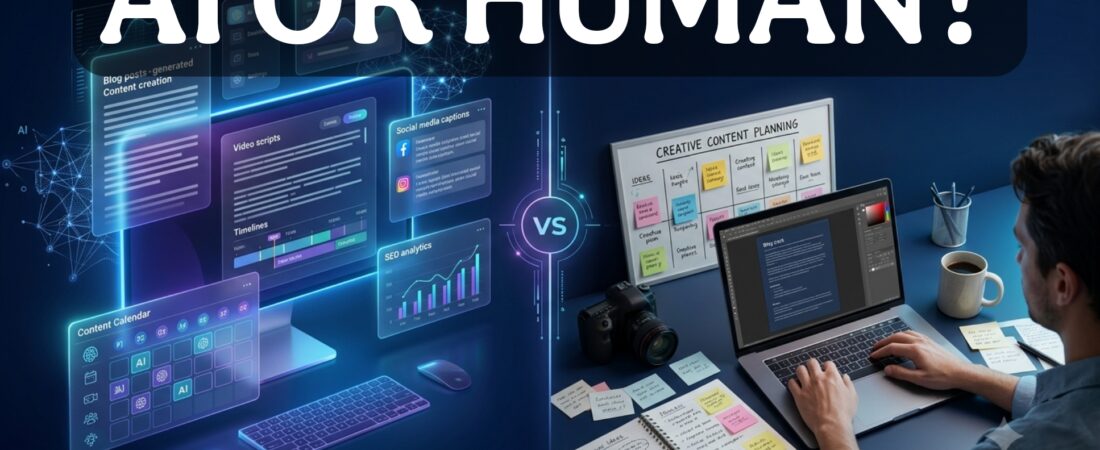
Content creation has evolved faster in the last few years than ever before.
Not long ago, creating a single blog post or YouTube video meant spending hours researching, writing, editing, and planning every detail manually. Today, artificial intelligence can help creators generate ideas, write outlines, produce captions, create scripts, and even suggest thumbnails in just a few minutes.
As AI tools become more advanced, many creators are asking the same question:
Should I use AI to create content, or is manual content creation still the better option?
The answer isn’t simply “AI” or “manual.”
Each approach has strengths and weaknesses, and understanding them can help you build a workflow that saves time while maintaining quality.
In this guide, we’ll compare AI content creation and manual content creation, explore their pros and cons, and explain why the most successful creators in 2026 combine both methods.
What Is AI Content Creation?

AI content creation refers to using artificial intelligence to assist with producing digital content.
Instead of starting from a blank page, creators use AI tools to speed up repetitive tasks such as:
- Generating blog ideas
- Writing outlines
- Creating video scripts
- Producing social media captions
- Generating hooks
- Brainstorming titles
- Improving prompts
- Repurposing existing content
Popular AI assistants like ChatGPT and Gemini have become valuable tools for creators because they reduce the time spent on repetitive work.
However, AI is still a tool—not a replacement for creativity.
– Top Free AI Tools Every Content Creator Should Use In 2026
What Is Manual Content Creation?
Manual content creation means creating everything yourself without AI assistance.
This includes:
- Researching topics
- Brainstorming ideas
- Writing drafts
- Editing content
- Planning publishing schedules
- Optimizing content for SEO
Before AI became widely available, this was the only workflow creators had.
Although it takes more time, manual creation gives creators complete control over every detail.
Advantages Of AI Content Creation
1. Faster Content Production
One of the biggest benefits of AI is speed.
Tasks that normally take hours can often be completed in minutes.
Need ten blog ideas?
Need five YouTube titles?
Need multiple hook variations?
AI can generate them almost instantly.
For creators publishing several times each week, this can significantly reduce workload.
2. Easier Brainstorming
Creative blocks happen to everyone.
Even experienced creators sometimes struggle to find fresh ideas.
AI works well as a brainstorming partner by suggesting different angles, formats, and perspectives you may not have considered.
You don’t have to use every suggestion, but they often provide an excellent starting point.
3. Better Productivity
Instead of spending an entire afternoon writing a rough draft, creators can begin with an AI-generated outline and focus their energy on improving the content.
This allows more time for editing, research, and creative thinking.
4. Content Repurposing
One video can become:
- A blog article
- Five social media posts
- Three YouTube Shorts
- An email newsletter
- A LinkedIn post
AI makes repurposing content much faster than doing everything manually.
Advantages Of Manual Content Creation

Despite AI’s speed, manual creation still offers several advantages that technology cannot fully replace.
1. Authenticity
People connect with people.
Personal stories, experiences, failures, and lessons create trust that AI cannot generate from its own experience.
If your audience follows you because of your personality, your unique voice becomes one of your greatest strengths.
2. Original Thinking
AI often builds on existing patterns.
Human creators introduce new perspectives.
Original opinions, creative experiments, and personal insights are what help creators stand out in competitive niches.
3. Better Emotional Connection
Storytelling requires emotion.
Whether you’re sharing a success, a mistake, or a challenge, genuine experiences usually resonate more strongly than generic content.
4. Stronger Brand Identity
Creators who rely entirely on AI sometimes publish content that sounds similar to everyone else’s.
Manual editing helps maintain a consistent tone and recognizable brand voice.
The Biggest Limitations Of AI
Although AI is incredibly useful, it has limitations.
Generic Responses
Simple prompts often produce simple answers.
Without context, AI may generate content that feels repetitive or lacks originality.
Occasional Inaccuracies
AI can make factual mistakes or present outdated information.
Always verify important facts before publishing.
Limited Personal Experience
AI can explain a concept.
It cannot replace real-life experience, opinions, or lessons you’ve learned personally.
Those are what make content memorable.
Dependency
Some creators publish AI-generated text without reviewing it.
Over time, this can weaken content quality and reduce originality.
AI should support your workflow—not replace your judgment.
– How To Write A Professional LinkedIn Bio Using AI
The Challenges Of Manual Content Creation
Manual creation isn’t perfect either.
It Takes More Time
Research, writing, and editing from scratch require significant effort.
This often limits how much content creators can publish.
Creative Burnout
Publishing consistently while generating new ideas every week can become mentally exhausting.
Even experienced creators experience creative fatigue.
Slower Growth
If every task is completed manually, creators may struggle to keep up with competitors using more efficient workflows.
AI vs Manual Content Creation: Side-By-Side Comparison
| AI Content Creation | Manual Content Creation |
|---|---|
| Faster production | Slower workflow |
| Great for brainstorming | Better original ideas |
| Easy to scale | Stronger authenticity |
| Excellent for repetitive tasks | Better emotional storytelling |
| Saves time | Builds a unique brand voice |
Neither method wins every category.
Each solves a different problem.
The Best Workflow For Modern Creators
The creators growing the fastest in 2026 aren’t choosing AI or manual creation.
They’re combining both.
A practical workflow looks like this:
- Research topics manually.
- Use AI to brainstorm ideas.
- Generate an outline with AI.
- Write the first draft.
- Add personal experience and insights.
- Edit everything manually.
- Optimize for SEO before publishing.
This approach combines AI’s speed with human creativity.
When Should You Use AI?
AI works best for:
- Content planning
- Hook generation
- Blog outlines
- Caption writing
- Brainstorming
- SEO optimization
- Prompt generation
- Content repurposing
When Should You Rely On Yourself?
Manual creation is better for:
- Personal stories
- Opinions
- Case studies
- Tutorials based on experience
- Brand messaging
- Final editing
These areas benefit from authenticity more than automation.
– 20 Viral Hooks You Can Copy & Adapt For Your Next Video
Final Thoughts
AI content creation and manual content creation shouldn’t be viewed as competitors.
They are complementary tools.
AI helps you move faster.
Human creativity gives your content personality, credibility, and trust.
The creators who succeed in 2026 won’t necessarily be the ones using the most AI.
They’ll be the ones who know when to use AI—and when to rely on their own experience.
Use AI to eliminate repetitive work, but let your ideas, expertise, and voice shape the final content.
That balance is what turns efficient content into valuable content—and valuable content is what audiences remember.